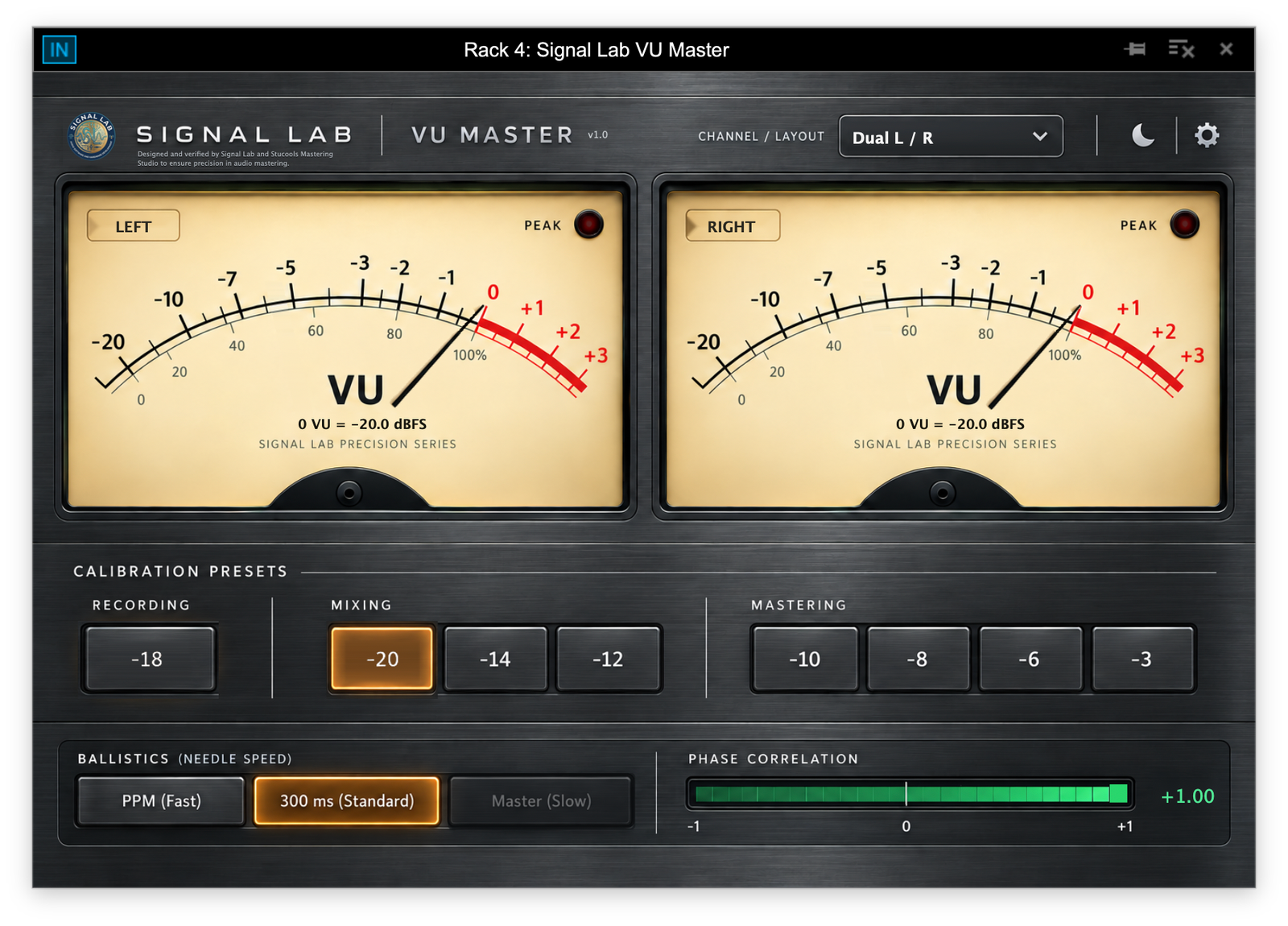
Difference between VU Meter and Digital Meter (ppm/Peak Meter)
Although high-precision digital meters (such as True Peak or LUFS) are available today, many professional mastering studios continue to place the VU Meter (Volume Unit Meter) in the Signal Chain.
💡
Key takeaways: Difference between VU Meter and Digital Meter (ppm/Peak Meter) The key difference is in the speed of response (Ballistics) and what the meter measures.
Model | VU Meter (Volume Unit) | Digital Peak Meter (dBFS / True Peak) | What was measured | Average Energy (Average / Continuous Energy) Close to RMS | Immediate signal peak (Peak / Transient) | Response Speed (Rise Time) | slow (~300 ms) The needle did not wiggle following the short impact sound. | tely. (0–1 ms) Catch the top of the wave for even a split second. | Resume Behavior Transient | Ignore the short noise. ulture Snare OR Click | Capture Amount Transient All tablets To block clips (0 dBFS) | Scales and actions Calibration | The unit is %. VU (0 VU Often set on an equivalent -18 To -14 dBFS) | The unit is %. dBFS (Fixed ceiling at 0 dBFS) |
| |
|
|---|
Why Mastering Studio Still Uses VU Meter
- Responds Nearly to Human Ear Hearing (Perceived Loudness)
The human ear does not judge loudness from a short transient (such as a buzzing head or a snare impacting drumstick), but senses from a "continuous energy" delay averaging about 300 ms of the VU Meter, thus naturally matching the brain's loudness sensing mechanism, allowing the Engineer to balance the tightness of the song without having to focus on numbers.
- Analog Hardware "Sweet Spot" Control
In the Mastering phase, Analog Outboard Gear (e.g., Pultec EQ, Shadow Hills, or Manley Compressor) is often used. These pro audio devices are designed to be as complete as possible when the signal is input at +4 dBu (which corresponds to 0 VU). Keeping the needle in the 0 VU area guarantees that the Transformer circuit or tube is operating at the point where Harmonic Saturation is most beautiful, without breaking too much.
- Immediate dynamic headroom (Crest Factor) when viewed in conjunction with Peak Meter.
When viewing the VU Meter in tandem with the Peak Meter, engineers will immediately know the difference between “Average Energy” and “Peak”:
If the Peak Meter hits 0 dBFS, but the VU needle is only -7 VU, it means that the music has a very wide dynamic (high-pitched transient, but the sound is thin).
If the VU needle hits 0, the VU is immersed, but the Peak Meter is barely moving, it means that the song is pressed Compression/Limiting until it is flat, lacking dimension.
- Reduces visual fatigue (Visual Ergonomics)
Looking softly at the moving physical needle provides a smoother overview of the groove and the music energy than staring at the constantly flashing digital led graph.
In actual work, Studio Mastering does not use the VU Meter to replace the Digital Meter, but instead works together using Digital True Peak/LUFS to control the streaming standard ceiling to avoid distortion, and using the VU Meter to control the power level, audio content, and drive the analog hardware to where it belongs most.
| |
|
| |
|